
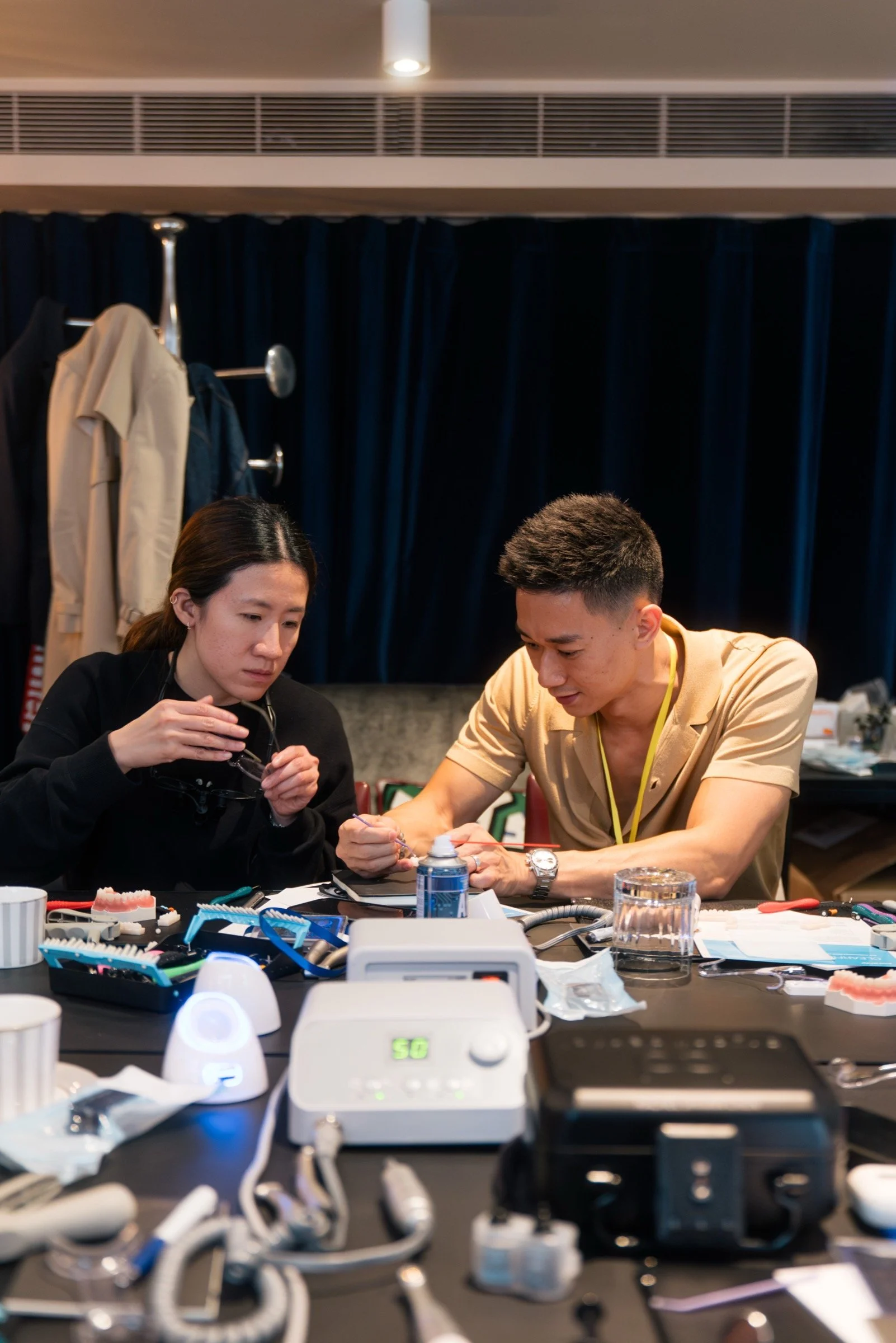
Contemporary Restorative Endodontics
The Premise:
This course exists because the course we wanted didn’t.
Most endodontic teaching places inadequate emphasis on the restorative component of the treatment continuum — as though the restoration that follows is somebody else’s problem.
We built a course that moves the two together — with structured peer-to-peer case reflection and senior faculty present throughout to support your case learning.
It is the course we believe in, and we hope it becomes the course you needed.
Our teaching Philosophy:
For twelve years, Contemporary Endodontics has run bespoke, small-group, hands-on training focused on the clinical problems dentists meet every day. Incidental Training has done the same for restorative dentistry. We have come together, with substantial combined experience between us, to build the course we have always wanted to take.
The course follows a deliberate progression:
Transforming clinical skills → building confidence → building technique → building consistency → building complexity.
These are the steps that deliver clinical excellence to your patients — and that, over time, widen the portfolio of cases you can confidently treat.
Who is this course for?
You should consider this course if:
You want to comprehensively build your endodontic clinical skills and decision making taught by genuinely expert and experienced clinicians
You take referrals — or want to — and need your endodontics and your restorative thinking to integrate
You learn by doing, and you are open to hard work!
The Shape of the Course
8 in-person days — four modules of two days, Thursday and Friday, 9am–5pm
6 live webinars — two between each module, led by Jon or Luca
One year of contemporaryendo.com — on-demand access to support your learning before, during and after
Structured case reflection log — 3–6 cases per delegate, with peer-to-peer review
Cohort 1 launches February 2027 — limited places
-
Module 1 — Fundamentals of Endodontics
Two days in person · Followed by two webinars
The foundation everything else sits on. We go back to first principles — case assessment, prognosis, restorability — and forward to the techniques that are the cornerstone of modern restorative endodontics. Hands-on the whole way through.
Case assessment and prognosis
Restorability — the decision that should come first
Access — modern principles
Canal shaping — the principles, then the systems (multiple instrument systems explored hands-on)
Irrigation protocols that can move you towards single-visit endodontic treatment
Fundamentals of obturation, including warm vertical compaction
Webinars 1 & 2: Cases presented and treated by delegates. Peer-to-peer appraisal. Faculty feedback. Logbooks live throughout.
-
Module 2 — Building Complexity
Two days in person · Followed by two webinars
The canals that make endodontics hard. We work through calcified, ledged and curved canals; anatomically driven preparation; and the obturation scenarios that catch most clinicians out.
Managing the calcified canal
Managing the ledged canal
The curved and S-shaped canal
Anatomically driven preparation — choose the approach that suits the canal
Complex obturation: oval canals, confluent canals, bifurcating canals, internal resorption defects
Managing the open apex — collagen barrier and hydraulic putty technique
Webinars 3 & 4: Delegate cases with complex features.
-
Module 3 — Restorative Integration
Two days in person · Followed by two webinars
This is the module no other endodontic course delivers. It is taught by Chris O’Connor and Ollie Bailey of Incidental Training — restoratively-focused practitioners whose work complements the restorative endodontic philosophy taught throughout.
Restorability assessment is taught in Module 1 and covered in the pre-module asynchronous content. These two days build the workflow that follows the endodontic treatment — and it is the most comprehensive restorative teaching found on any long endo course.
Core fillings — done properly
Deep margin elevation
Matrix choice and Class II strategy
Pre-endo vs not pre-endo — the decision tree
Fibre and titanium post placement
Short fibre composites
Onlays, crowns and vertipreps
Temporary crowns
Webinar 5 — Restorative case clinic. Delegate cases discussed at depth.
Webinar 6 — Live-streamed four-handed simulated consultation and clinical treatment, from our surgery in Bath.
We will open the doors of Circus Dental and stream a simulated consultation appointment and a simulated four-handed clinical treatment in real time. You will see the workflow as it actually runs — the conversation, the records, the planning, the consent, then the treatment itself. The closest thing to standing in our practice without flying south.
-
Module 4 — Endodontic Re-treatment
Two days in person
Learn the techniques to make excellent yet quick decisions to ensure you pick the cases that are winners — and the techniques to efficiently re-treat most cases.
GP removal — multiple techniques
Thermafil removal — multiple techniques
Metal post removal
Fibre post removal
Two simulated cases, end to end. Full workflow on a complex case, recapping every skill taught across the course. Logbook sign-off. Cohort 1 finishes here.
The hybrid phases — what happens between modules
The online phases do real teaching work. They protect the in-person time for what only in-person can deliver, and they protect your practice diary by keeping out-of-surgery time to two days per module.
Each of the three hybrid phases includes:
Two 90-minute live webinars — Jon or Luca leading, cases drawn from the cohort
Case submission deadlines — full imaging, structured reflection
Cohort discussion forum — live throughout
Pre-block release of preparation content — primes your thinking before each in-person module
How you’ll learn — the three-layer reflective structure
This course is built around how dentists actually develop judgement. Not by being told they’re right by a specialist on every case, but by reflecting, being reviewed, and engaging with cases that aren’t theirs.
Your own thinking. You document each case in a structured reflection log — full imaging, decision points, what you’d do differently, what surprised you. The act of writing your reasoning is where the learning lives.
Your peer. You are paired with another delegate for the duration of the course. You exchange logs and imaging using a faculty-supplied prompt framework. You give and receive structured, depersonalised feedback. Critiquing another dentist’s thinking sharpens your own faster than anything else.
Your faculty. Cases are curated across the cohort and are discussed at depth in the webinars by Jon, Luca, Chris or Ollie. We encourage delegates to engage in this process.
What you’ll leave with
A library of your own reflected cases, fully imaged, ready to inform your next decade of work
A peer relationship that, in our experience, tends to outlast the course
Confidence in shaping, irrigating and obturating across the full clinical spectrum, including the complex cases most courses avoid
The restorative judgement to know when and how to build, post, onlay, crown — and when not to
The clinical judgement to know when to retain, when to retreat, and when to refer
A year of on-demand access to contemporaryendo.com
Verifiable CPD certificate — [hours TBC]